The Work Environment of Dr. Red Nose
In dramatic structure, the questions of the five Ws—today, we would like to talk with everyone about “Where.”
The setting for Medical Clown’ performances is not a theater, not a circus, and not the street, but a “hospital.” This setting is indeed somewhat special. That is why, when Michael Christensen, one of the founders of the Big Apple Circus, first proposed the idea of entering hospitals to provide clown performances for children, a hospital administrator replied, “A hospital is not a place for clowns.” But with the efforts of many people and the evolution of medical concepts, Medical Clown now appear not only in hospitals, but also in sanatoriums, geriatric wards, refugee camps…and everywhere in the world that needs to rediscover the joy of laughter.
However, the services provided by Medical Clown are neither easy nor spontaneous. Before entering a workplace, we must do a great deal of preparation, including understanding the spatial design, the characteristics of the staff, and the working atmosphere of that setting. Only with thorough preparation can we provide the best service. The involvement of Medical Clown is intended to enhance the delivery of compassionate healthcare, not reinforce the stereotype that “clowns only cause trouble.”
Therefore, in addition to maintaining close contact between the administrative and medical teams, we also need to introduce our organization, service methods, and interaction models to the medical staff on the front lines of service. We communicate that we will absolutely respect their expertise and work, and cooperate with them on that basis. Know yourself and know your opponent, and you will never be defeated!
Regarding spatial design, some services take place in general wards, so Medical Clown must know the order of priority. Sometimes there are isolation wards or negative-pressure isolation rooms, designed to protect children who may have weaker immune systems. Therefore, when conducting one-on-one, customized improvised performances in each ward, this affects how Medical Clown plan the order of their entire rounds or visits, in order to protect children with weaker immune systems and avoid the risk of cross-infection.
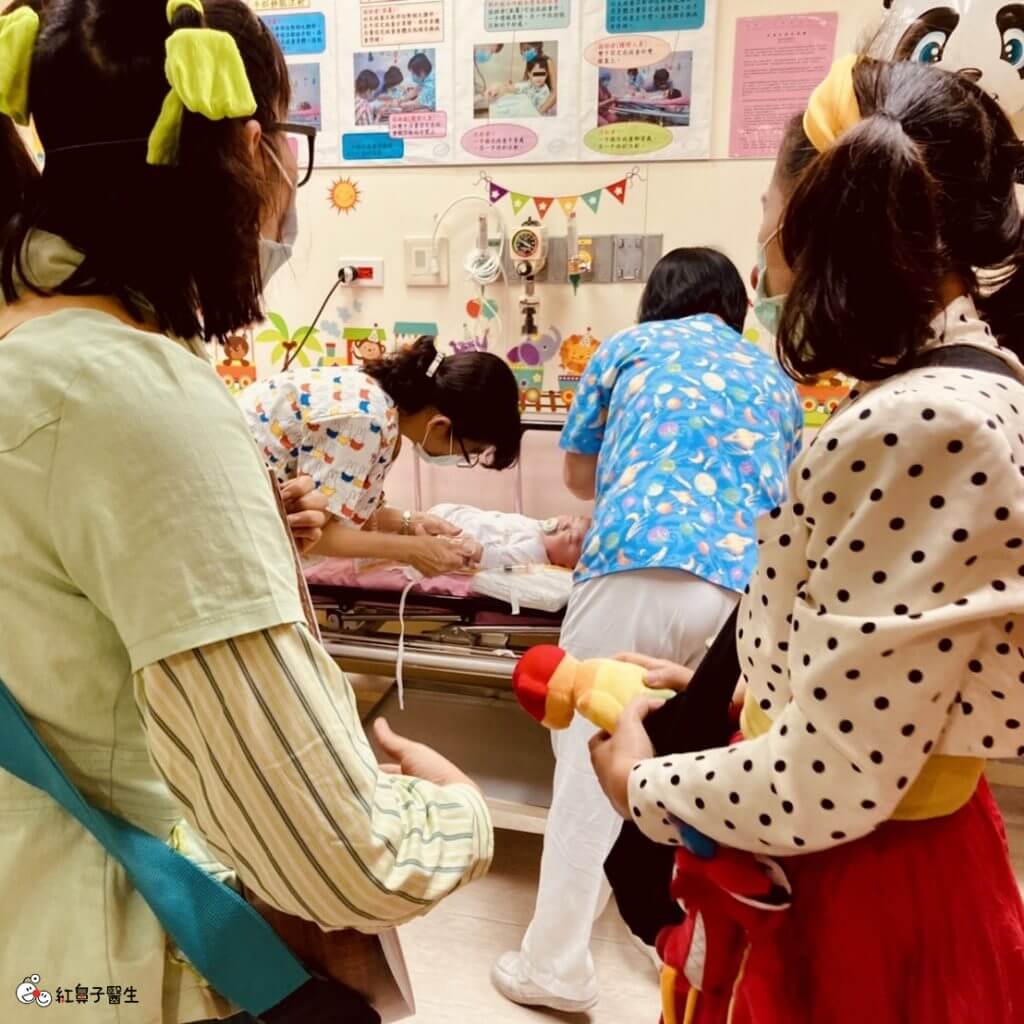
Medical personnel are also among the people we serve. Medical Clown interact with them as well, but always on the principle of not disturbing them. When needed, Medical Clown can also undertake the challenging task of “medical companionship.” During invasive procedures, if we can divert a child’s attention and help them relax while receiving treatment, the medical staff can also carry out their work more smoothly. Or, through comforting companionship after treatment, we can help children forget the pain they have just experienced and ease their discomfort.
For different specialized services, Medical Clown first learn about the space, routines, and guidelines. For example, when providing services in an intensive care unit, we must understand the meaning of various warning signs—such as knowing that a certain icon indicates contact isolation and that protective clothing must be worn, as well as which periods are designated visiting hours for parents—and, based on the circumstances, provide suitable interactions or leave space when appropriate.
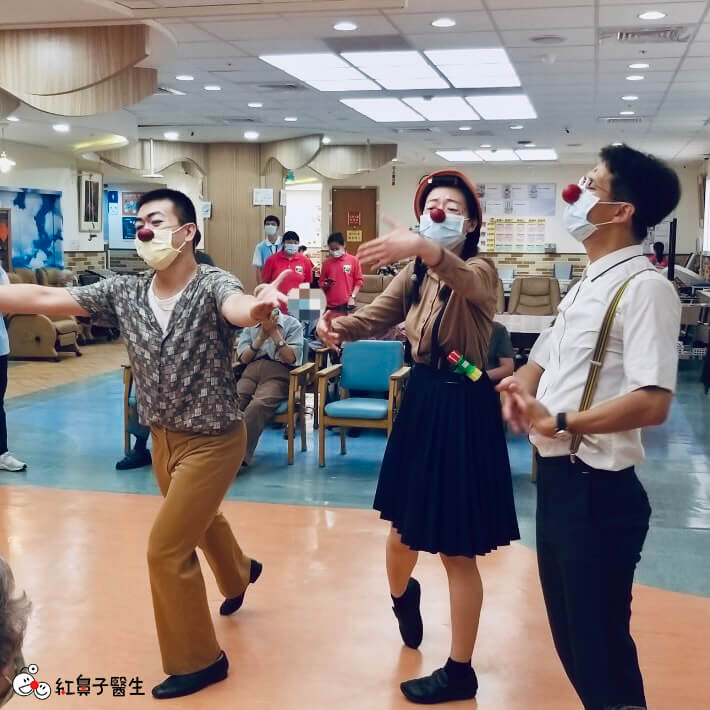
Because the performances are customized, they must also be adapted to the setting. For example, in 2018, Dr. Red Nose began planning services for older adults. We invited many relevant experts, as well as instructors from France with extensive experience in clown companionship for older adults, to provide intensive training for all Dr. Red Nose. Through continuous learning and development, we explore new fields and establish new forms of service. For instance, the spatial use and functions of day-care centers and geriatric wards differ from those of pediatric wards. Older adults complete many different types of courses or activities together in these spaces. Compared with one-on-one ward services, Medical Clown must adjust the content and approach of their performances. Thus, we changed the usual two-person performance team into a three-person team. Through the design of situations and roles, and by coordinating with their setting and daily routines, we join the older adults in having fun.
For Medical Clown, every service is both connected to the others and independent in its own way, because every medical space has different attributes and characteristics, and every patient’s needs and responses in the moment are different as well. That is why every performance service is so unique! Whenever a new service location is opened, Medical Clown enter the ward area, which may seem like the beginning, but before that, we have already spent a great deal of time preparing, communicating, surveying, understanding, and researching. We must be fully prepared before we can finally enter these spaces and gather each touching smile.

Written by: Hsieh Hui-Chun (Little Flower)