Dr. Red Nose – Physicians in the Pediatric Ward Who Specialize in “Playing”

It is a weekday morning in the pediatric ward.
At 9 a.m., many doctors and nurses were already coming and going at the nurses’ station. At that moment, two people entered from outside dragging suitcases. After briefly greeting everyone, they quietly walked into the lounge.
When they opened their suitcases, they found clothes and props in all kinds of bright colors. The two changed into their costumes, tied up their hair, sat down, and lightly painted a few strokes of color on their faces while looking in the mirror. Finally, they put on red noses, and immediately transformed into clown characters.
The two clowns each had a distinct personality. Through a back-and-forth warm-up, they established a rapport with each other. Next, they put the day’s list of inpatients into their pockets, began playing music, and walked out of the lounge. They sang and paraded in circles along the ward corridors.
They hummed, and the notes drifted into the rooms, gently stirring the atmosphere throughout the ward, as if greeting the children and their families: “Hey, Dr. Red Nose are here again!” After circling the corridor, the two clowns were about to enter each room, based on the patient information provided by the head nurse, and face children whose physical conditions, moods, and mental states were all different. They would tailor an improvised playful interaction for each child. As for how the child would respond? Unknown!
The above is the general process followed by the clown performers of Dr. Red Nose Clown Care Association when they visit the pediatric ward each week. It is also what my everyday work in the wards has been like over the past four-plus years as one of Dr. Red Nose performers.
At the end of 2017, I passed Dr. Red Nose Association’s six-month selection process, training, in-hospital internship, and assessment. I became one of the first group of clown performers to be regularly stationed at hospitals in southern Taiwan. To date, I have accumulated approximately 220 ward performances. At first, like many people, I thought a clown was simply a performer who deliberately exaggerated things to be funny. But after actually taking part, I discovered that it was not like the stereotype at all.

What are the “Dr. Red Nose”? They are a group of actors who wear red-nose masks and enter medical settings, using the performance techniques of theatrical clowning to improvise with patients in all kinds of situations. It is a practice of “medical clowning” that combines theatrical art with the humanistic meaning of medicine.
These performances are not intended simply to achieve art in the narrow sense. Instead, with the child at the center, the clowns sensitively observe the child’s physical and emotional state at that moment, as well as clues from the people and things around them, and look for a starting point for interaction. The clown character does not pursue variety-show-style or stereotypical humor. Rather, the clown sincerely faces their own emotions and thoughts in the moment, transforms them into theatrical reactions from the inside out, and then waits for responses from their clown partner and the child. Together, they develop a dramatic interaction with situational buildup, tension, and an appropriate ending.
In other words, Dr. Red Nose have no fixed script. They rely entirely on the “in-the-moment” interactive connections between the clown performers and the children, family members, medical staff, and the ward itself. Often, they are really looking for materials that can be “played with” in “reality,” inviting one another to exercise their imaginations and “play” together.
So here comes the question: Why “play” in a hospital, a setting that requires quiet and order? Won’t it be noisy? Won’t it be dangerous? Treating illness is the top priority—is playing really necessary? …Many uncertainties about “playing in the ward” may arise in people’s minds, including mine at the beginning.
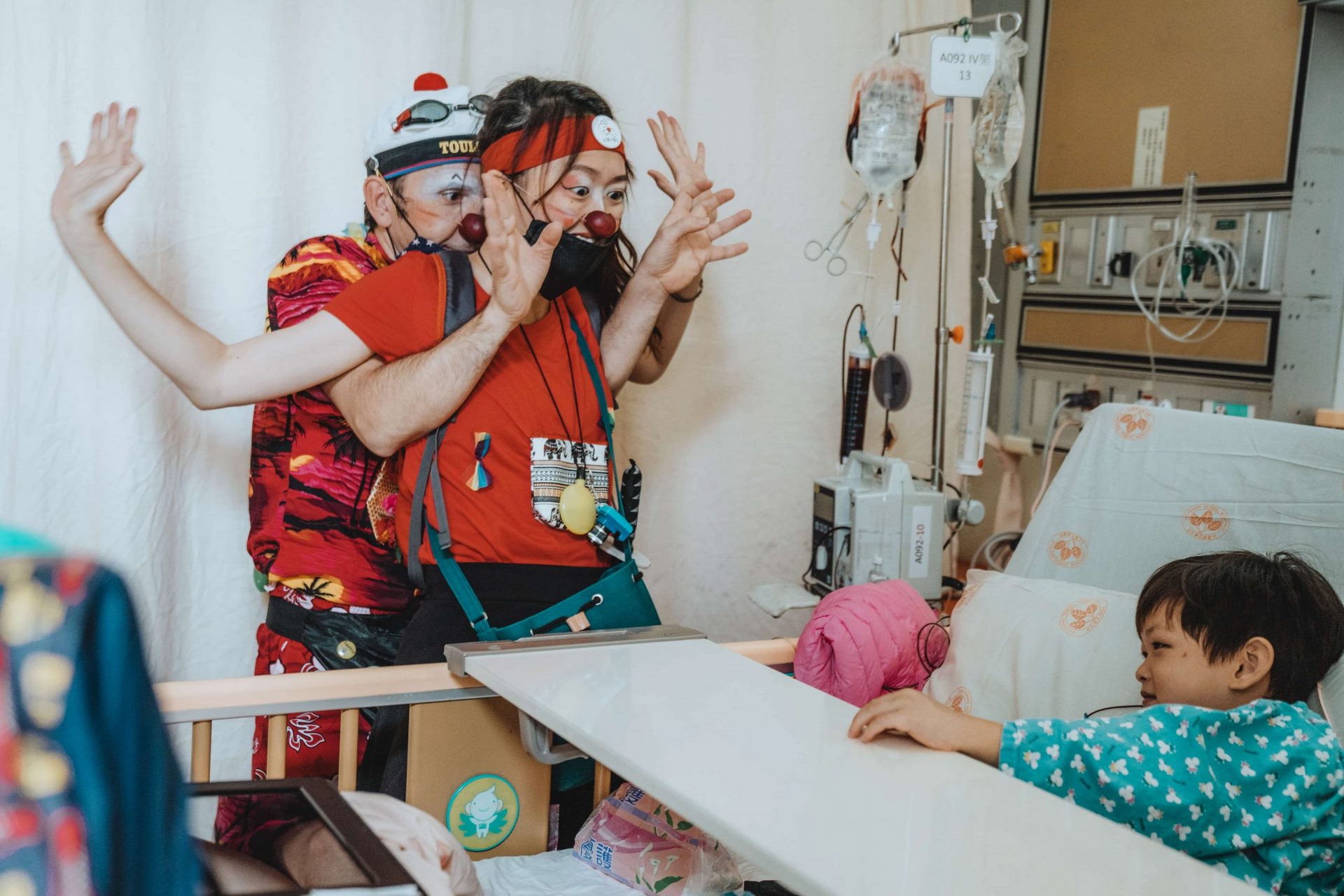
I remember the first time I entered a children’s ward for an internship and observed experienced clown performers from Taipei. When I saw them walk out of the lounge and start playing and singing songs in the corridor, I was deeply shocked. Although they were not intentionally shouting, simply seeing these two people in “strange costumes” up close in the plain ward, playing instruments and singing in a corridor that was supposed to be “completely quiet,” brought to the surface all my habitual notions of what a hospital “should look like.” All of those notions were jolted by the presence of the two clowns. At the time, I was even nervous for them: “Won’t singing like this the whole time be too noisy? Won’t the children be disturbed? Won’t the doctors and nurses get angry? …” Worries like these kept echoing in my mind.
But as I continued observing the clowns from a distance, I found that although some wards did indeed become somewhat stirred up, it was not the anger or sense of being disturbed I had imagined. Instead, there were expressions of anticipation. At the nurses’ station, although the busy nursing staff had their heads down over their work, some of their faces instantly relaxed when they heard the music or encountered the clowns awkwardly approaching to say hello.
Later, the experienced clowns entered a room and first built a relationship with the children’s families. Once everyone gradually developed a rapport, someone suggested that they put on a “concert” together. The children and family members at every bed in the room were clearly interested, and their eyes lit up. Then, someone—I don’t know who—turned off the ward lights. The clowns took out flashlights, while the family members used their phones to shine light. Everyone sang together in the darkness, waving the lights in their hands, and the room suddenly became a sea of light. After singing once, it still wasn’t enough, so everyone enthusiastically sang together loudly a second time. The orderly, powerful singing and cheers after the song ended echoed through the room.
As everyone sang in an intoxicated state of delight, I, observing from the side, sang along and could not help getting goosebumps. In the weighty reality of a pediatric oncology ward, there could be such a lighthearted moment. The smiles on everyone’s faces, the satisfaction in their voices, and the reluctance to part as they dispersed and exchanged blessings were, in that brief moment, a reality that everyone had joined together to create. Such joy filling the room may have been something they, after long hospital stays, had not experienced in a very long time.
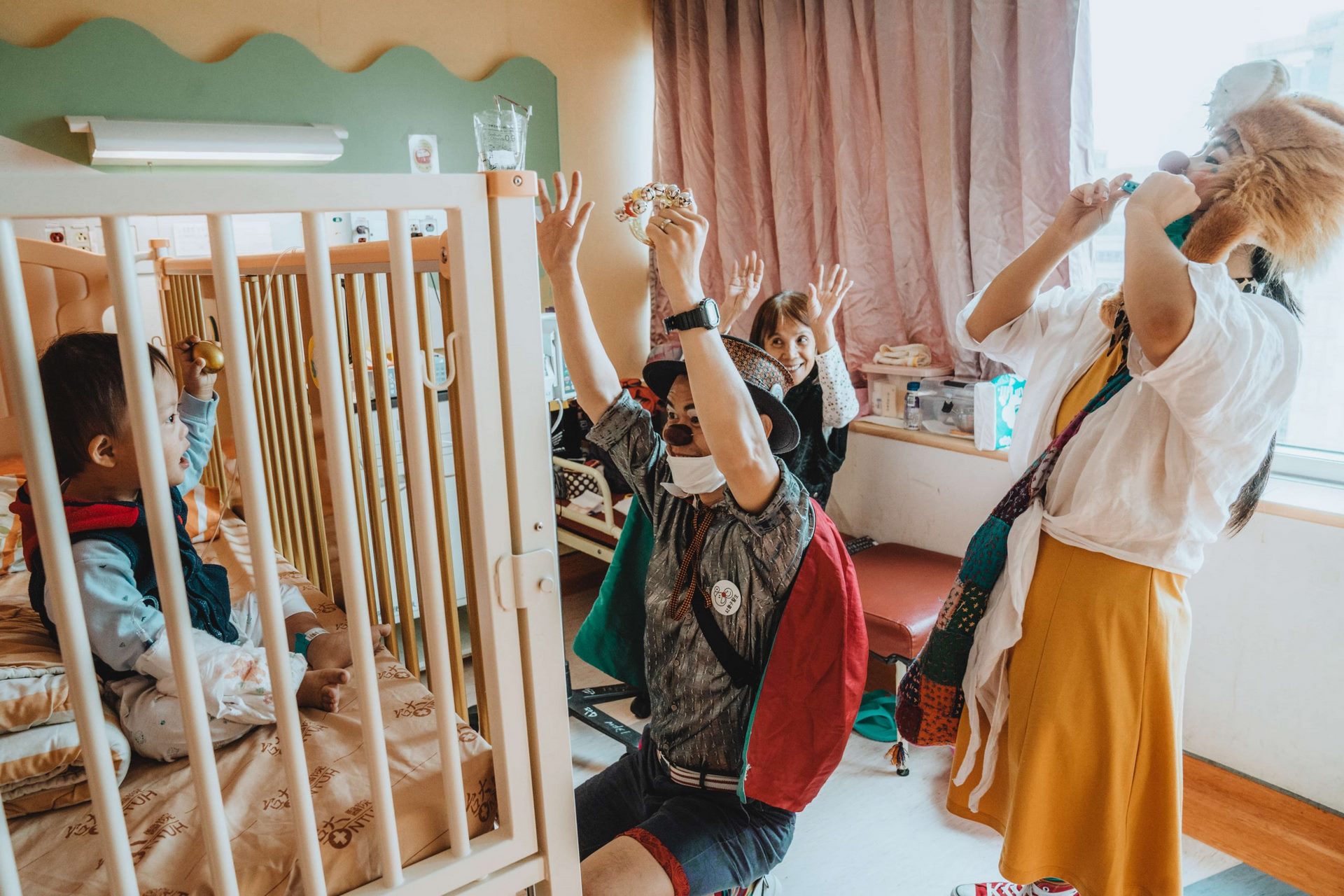
Later, throughout the long journey of continuing to learn and practice as a Dr. Red Nose, I increasingly came to understand the value of Dr. Red Nose’ presence in the wards—especially pediatric oncology wards. “Playing” and “games” may at first glance seem childish, impractical, disruptive to the existing order, and impossible to easily quantify into empirical data proving benefits to physical and mental well-being. Yet they are basic human needs and instincts. Because Dr. Red Nose interact with children at each bed, the children’s feelings and thoughts become material for the game. Sometimes we respond with gentle empathy according to the situation; at other times, we offer playful stimulation. These situational invitations to play create an opening in the otherwise fully scheduled life of hospitalization. Children can step through it—or watch from the doorway—and make choices according to their preferences. The clowns experience a creative form of interaction with them and help them express the voices they want to send out.
Dr. Red Nose are not an occasional volunteer service. Rather, they are founded on cooperation between the association and hospitals, with trained clown performers regularly stationed there, performing in the wards one or two fixed days each week, year-round. When clowns appear regularly in the wards over the long term, I believe we are members of the broader ward work team. Clowns and medical staff simply specialize in different things. In medical settings, clowns use the aesthetic distance of theater to co-create imaginative emotional interactions and outlets for expression with everyone. At the same time, clowns need to—and can—form practical working relationships with medical staff. Through their respective specialties, they complement, respond to, and support one another, jointly forming a child-centered network of compassionate healthcare relationships.
Since becoming a Dr. Red Nose, I have not had a single day when I did not feel that the clown’s presence in the ward was “out of place”—whether because of our vivid appearance or our various clumsy yet honest actions. Yet it is precisely this fearless stance, both out of place and entirely natural, that gives the theatrical clown character the greatest ability to stand between reality and the virtual world. It allows us to accompany children through safe, permitted, and supported play in the hospital, gently bridging or transforming, through a lighthearted form, the burden of living alongside illness. Dr. Red Nose is a seemingly simple but actually complex and difficult role. Dr. Red Nose Association continually makes every effort to arrange various kinds of training so that clown performers can continue to grow and reflect. We must keep exploring the flexibility and wisdom of play in order to shoulder the responsibility of being “doctors” who specialize in “playing.”
If you support Dr. Red Nose’ public-interest work, you can help us move this great wheel forward together in the following ways:
Written by: Tseng Ching-wen (Southern Taiwan performer, Red Nose Clown Care Association)