Dr. Red Nose’s Diary – Dear Elders
I crouched down in front of him. His eyes remained fixed on mine as he spoke intently to me, even though I couldn’t understand Taiwanese.
His eyes were especially bright, like the sun. He wasn’t worried at all that I couldn’t understand him; he believed I would surely understand. No matter what language we use, feelings are something we all share.
He was right.
Even though I couldn’t understand the words, I could still pick up on other signals. His eyes could speak; his body, his entire being, especially his hands—that pair of hands that kept holding mine—all made me feel incredibly warm.
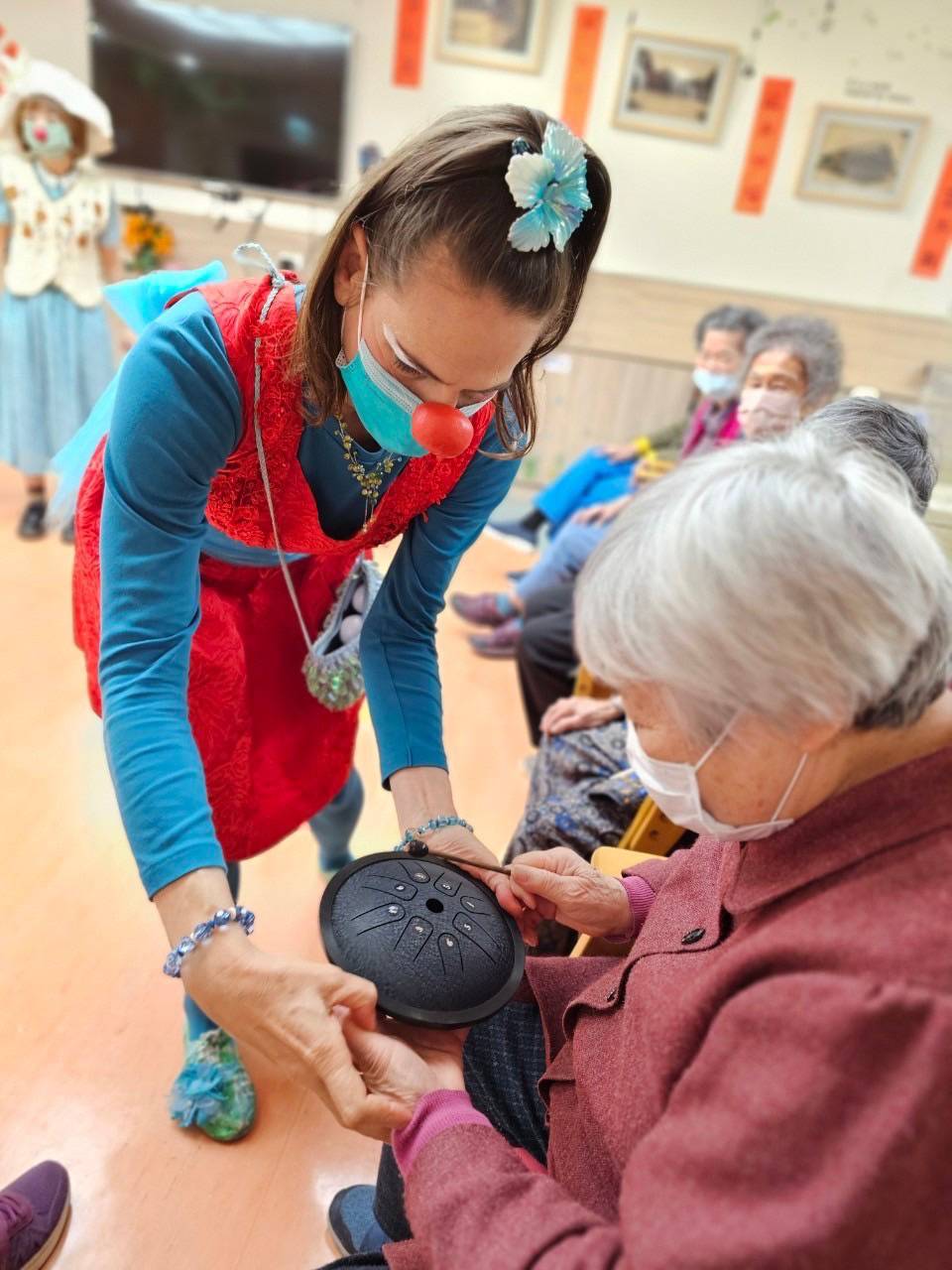
(Pictured: Dr. Red Nose Dui Dui performing at the Beirong Youyi Ju Day Care Center)
This is a story that took place on the fifth floor of Taipei Veterans General Hospital, about the oldest elders. They lived there, in the hospital.
For every performance, I brought my little guitar and sang Chinese and Taiwanese songs with my partners. The elders loved old songs, especially Teresa Teng’s songs—an eternal muse! The last time I partnered with Shrek, we even told everyone that he was Teresa Teng’s granddaughter, and spent a joyful day laughing together.
Our roles were clearly divided: one person sang lead while the other played guitar or sang harmony. If the elders were curious about foreigners, I would also sing French songs, mostly “La Vie en rose,” or “Life in Rose,” a melody that Taiwanese people are also very familiar with.
Every performance was both moving and joyful. We always laughed heartily. Performing for the elderly was truly fun; often, even after work, our mouths would feel sore because we had laughed so much.
I would like to share some memories that were both fun and moving.
There was an old grandmother who was unlike the others confined to their beds; she usually sat up in bed. She spoke only Taiwanese. Luckily, Shrek could speak it, so I watched from the side to figure out how to join in their game.
When she saw that I was a foreigner, she comforted me, saying, “Everyone in Taiwan will warmly welcome you, because sharing from the heart is something the whole world has in common.”
That was probably more or less what she meant. After all, I couldn’t understand a thing; Shrek told me afterward.
I crouched down in front of her. Her eyes remained fixed on mine as she spoke intently to me, even though I couldn’t understand Taiwanese.
Her eyes were especially bright, like the sun. She wasn’t worried at all that I couldn’t understand her; she believed I would surely understand. No matter what language we use, feelings are something we all share.
She was right.
Even though I couldn’t understand the words, I could still pick up on other signals. Her eyes could speak; her body, her entire being, especially her hands—that pair of hands that kept holding mine—all made me feel incredibly warm.
Sometimes I would look back at Shrek, hoping he could translate for me, but the old grandmother kept talking without pause, leaving no time for either an interruption or a translation.
She was so approachable, like a charming and kind fairy. When I left her room, I felt that one part of my heart was empty, while another part was full.
I said to myself, “Grandma’s words were an inspiration about the beauty of life, a teaching—a true teaching recorded in the classics and passed down through word of mouth until it reached me.”
That same day, we also met an old grandfather whose ears could no longer hear. At first, I thought communication might be difficult, but his caregiver shared a book with us containing his calligraphy and paintings, all of them beautiful and remarkable.
We looked through the book with him. He explained every painting and every chapter to us. We turned page after page together, like salmon swimming upstream along the river of memory. What a magical moment.
Next, we met another old grandmother. She was a little tired and unable to speak, and could only move her hands. We sang beside her bed while the person accompanying her helped her hold our hands. Grandma squeezed very hard and pressed her thumbs against our hands. Her caregiver said she wanted to tell us that she was happy, that she was saying “Great!” to us—that was the language she used.
So that’s what it was! She must have been both happy and moved that day, because she really did squeeze incredibly hard. Sometimes we turn that kind of “pain” into part of a playful performance, but that day we didn’t want to do that. We didn’t call out that it hurt; we simply and politely accepted her gratitude and emotion.
My hands are thicker, so I was fine, but Shrek’s hands are delicate. When we left Grandma’s room, I saw a red spot on Shrek’s hand that looked as if it were about to bleed. We couldn’t stop laughing—wasn’t that a bit too much!
There were also some people in the hospital who told us they didn’t want to sing, but as soon as we started, they joined in. Even while seated, they continued waving their slender, pale fingers as if dancing with us, never stopping—not even after the music had ended.
Many times, the elders would hold our hands and let our energy flow into them. We did not resist, allowing the years to fill every one of our moments. At those times, we became “transmitters of energy.” I loved those moments. We even wished we could give them all our energy, because we still had many opportunities to recharge.
On another occasion, my partner Nunu and I met two truly incredible people, each with a very distinctive personality.
The first was Japanese. We met him sitting in a wheelchair in the hallway. I don’t know why, but he wasn’t in a very good mood at first; however, his mood changed quickly. He was full of energy. After some trial and error, Nunu and I found a way to communicate with him and spoke in English. In the end, when I told him that I couldn’t understand English, he laughed happily.
As it happened, we had just practiced a Japanese song, and Nunu knew the lyrics. The timing couldn’t have been more perfect. We sang it for him, and he loved it. He sang along with us in a hoarse voice. Clearly, it had been a long time since he had sung like that—like opening a valve that had been closed for a long time, with water gushing out endlessly!
He taught us another Japanese song, accompanying the lyrics with hand gestures. We chatted for a while longer and exchanged a few jokes before saying goodbye reluctantly.
The other extraordinary person was a 108-year-old grandfather. He sat in a chair waiting for us. He spoke very clearly and could completely understand what we said. However, of course, we had to speak close to his ear, and that’s when Nunu’s banana-shaped microphone came in handy (it was actually a cloth banana!).
When we finished singing, he practically leaped out of his chair. He took two bottles of drinks from the cabinet and insisted on giving them to us, saying, “I have nothing left. Here in this hospital, I have nothing at all, but I still want to give you a gift.” We left feeling confused and moved, but the story wasn’t over yet…
Later, we ran into Grandpa again in the hallway as he pushed his wheelchair. A nurse asked whether we wanted to take a walk sitting in Grandpa’s wheelchair. We had never imagined doing that before; without the nurse’s suggestion, we definitely wouldn’t have dared!
So Nunu sat in the wheelchair while this “super grandpa” pushed him, and we sang as we walked. Everyone on the entire ward turned to look at us, unable to believe their eyes. Our respect for him kept growing with every turn of the wheelchair. After all, even though Nunu is very thin, he still weighs as much as an adult!
After making a round of the ward, Grandpa said he needed to rest and declined the nurse’s suggestion to go around once more. In a way, that was a relief.
Before parting with Grandpa, we asked him what his secret to staying healthy was. Without a moment’s thought, he answered, “I don’t know anything!”
As the story draws to a close, we often shed tears—tears of emotion, tears of profound joy. It is the joy of sharing, the joy of feeling the elders enjoy brief moments of happiness in the sunset of their lives, filled with intense longing.
For our dear elders.
Written by: Dr. Red Nose Dui Dui (CAMILLE MARIANNE TRÉBUCHET)