紅鼻子醫生日記 – 成為一位紅鼻子醫生的起點與旅程
I have been fortunate enough to become part of the Red Nose Doctor performance team for more than three and a half years now. Even today, I often feel that this field is full of the unknown, and every performance is like welcoming a brand-new page.
In 2017, when the association recruited its first group of clown performers in southern Taiwan, I signed up rather cluelessly. Unexpectedly, I later received notice that I had passed the first round of examinations. Together with the other nine successful applicants, I traveled from Tainan and Kaohsiung to Taipei, where we trained all day from Monday to Friday for two full months, immersing ourselves in courses on performance training, medical knowledge, psychological exploration, situational simulation, and internships.
After class every day, I often felt exhausted and inadequate, and truly wondered whether I was suitable to be a clown performer. In particular, compared with the other nine young partners, all of whom had graduated from drama departments and devoted themselves professionally to performance, my strengths were not in performing, but in designing and leading applied drama workshops focused on particular issues or community organizations. Why, exactly, had I come to undergo this unfamiliar trial? Besides, I was in my thirties and nearing forty, almost a full generation older than everyone else. My physical stamina, creativity, and sense of shame were all clearly lagging behind theirs. What, exactly, was I doing here?
Although I had so many doubts about myself, for some reason, this practice setting called the “Red Nose Doctor” held a powerful pull, calling on me to be patient and carefully explore the scenery along the way.
During those two months of intensive training, I was immersed in a rather uncomfortable pressure cooker. Every day I worked harder than the day before—not to become “more perfect,” but to practice stripping away the armor of socialization and the comfort of habit, bravely revealing my vulnerable self in front of others, and allowing my inner confusion, helplessness, awkwardness, anger at being less skilled than others, shame, jealousy, greed….and so on, to become the core source of “being together” between the clown character onstage and the audience below the stage.
For me, clown performance is not “for the purpose of” making others laugh, but for inviting one another to honestly face the human world created at the intersection of you, me, and them. Clowns make audiences unable to resist laughing because they are honest enough and conceal nothing, allowing the audience to feel the contradictions or absurdities between them and the norms of socialization.
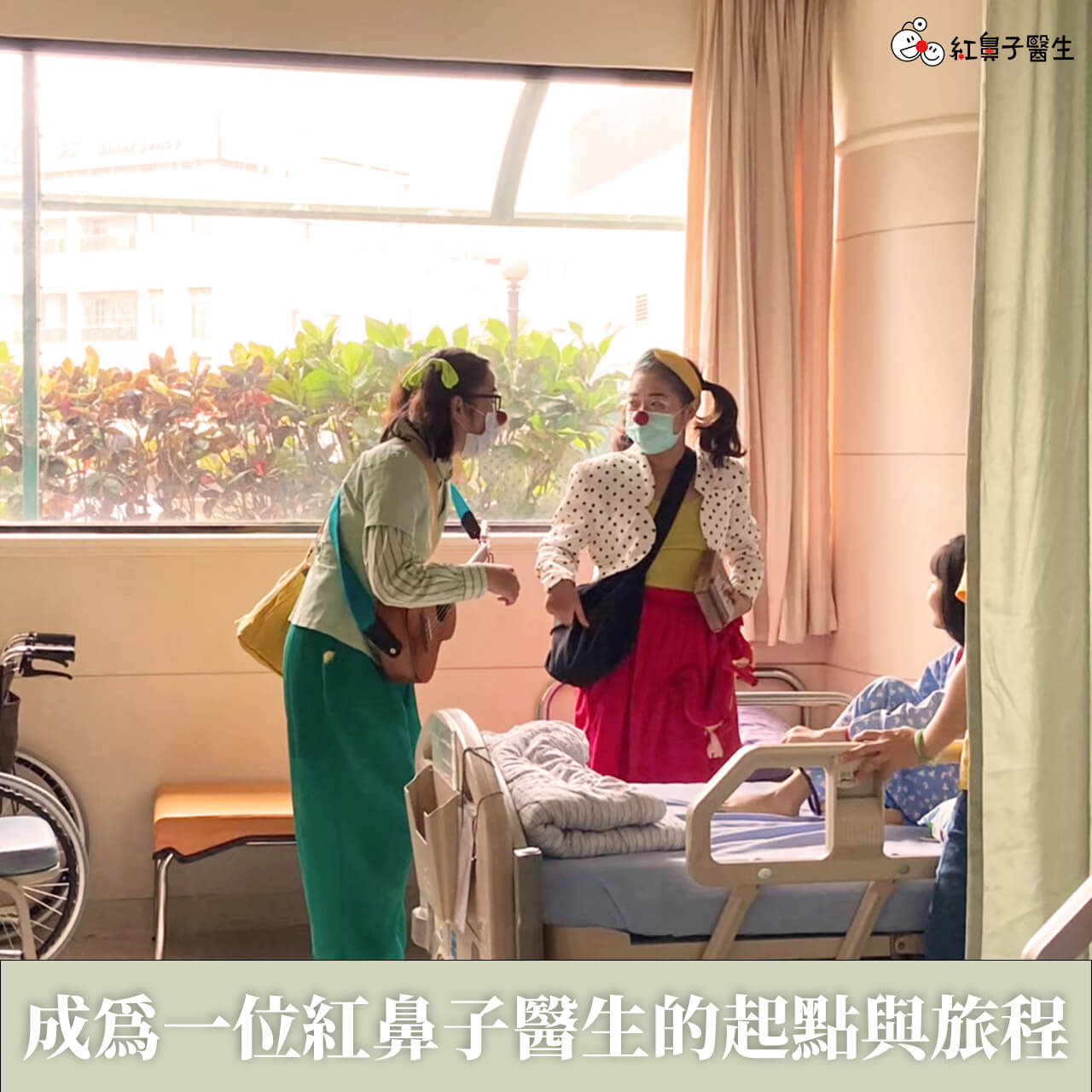
I remember that after we had taken many classes in the rehearsal space, we finally entered a hospital for the first time as interns. Simply observing the experienced clowns at work gave me an enormous shock as I felt the changes in atmosphere triggered by “clowns in the hospital”: the clowns played piano and sang in the corridors, breaking the quiet and restraint of the environment; in the wards, the clowns played together with patients and their families, jointly challenging the boredom or restrictions of their circumstances; at the nursing stations, the clowns teased and joked around with the medical staff, easing the tension of their working state….and so on.
A clown in a hospital is such an incongruous presence—wearing outlandish clothes and looking completely out of place simply by standing there, yet somehow gentle and harmless. Some people may think that clowns in hospitals are “there to cause trouble,” but with the right encounters and persistent attempts, clowns have the opportunity to co-create with the people they meet a transformative space-time in which “I am not merely a patient / a patient’s companion / a medical worker / a cleaner……” There, play gives us all kinds of possibilities that transcend the reality of the present moment.
I also remember the first time I put on a clown costume, performed alongside experienced clowns, and entered the first ward to play a game of “Finding the Treasure.” The grandmother accompanying the patient in Bed Three was sitting in a chair. When she saw us, she initially looked puzzled, but the next second she suddenly burst into hearty laughter that went on for a long time. As I was performing at that moment, my heart was completely melted by her laughter. I marveled silently: when laughter pierces an environment accustomed to quiet self-restraint, the resulting sound waves have such penetrating power.
After two months of intensive training in Taipei, on the day the course ended, I shared these complicated feelings with the group, and tears streamed uncontrollably down my face. I remember saying, “Being able to learn to become a Red Nose Doctor before turning 40 is such a wonderful gift from life.” After saying it aloud, I seemed finally to understand why I was here, and why I wanted to learn to use the performing arts of theatrical clowning to go into hospitals and interact with everyone.
In my many years of practicing applied drama, I have had to understand the real circumstances of the people I work with, read the context and knowledge related to the issues involved, and then meticulously design the activity process. I have also had to serve, in one group project after another, as the facilitator moving among various dynamics. Although I too am full of improvisation, spontaneity, and creativity, I had essentially, without realizing it, developed an aura of caution and seriousness, embracing a sense of solemn mission.
It was not until I encountered the Red Nose Doctor that I came upon the art of theatrical clowning, which has “neither a past nor a future.” A clown does not engage in complicated thought, but lives only in the present; a clown is full of innocence and enthusiasm, never gives up, and is not bound by social norms. All of this challenged my existing framework, while gently responding to inner aspects I rarely touched, leaving me so uncomfortable and yet so deeply called.
Training to become a clown who enters hospitals and improvisationally interacts with people at close range means treating clown performance as an end in itself, but also as a process. In other words, a clown performer must first face themselves honestly, gradually develop an awareness and technique for performing the art of theatrical clowning, and then, carrying a sensitive eye and an awareness of people and life, perceive all kinds of possibilities for play in the medical setting. Next, they place the focus of play on the process of interacting with the other person, facing our respective genuine feelings together, and expressing them honestly.
After writing so much about my memories from the initial training period, what I mainly want to say is that the Red Nose Doctor is an extremely distinctive practice of theatrical performance, because the performer is both themselves and the clown character at the same time. The clown character’s reactions come from the performer themselves, yet they must also maintain an aesthetic distance from the character. When the clown directly encounters people’s physical or emotional lows in the hospital, they come face-to-face with people’s sadness, anxiety, depression, anger, defensiveness, irritability….and other emotions. The performer and the clown character share laughter with everyone while also holding the sadness and loss brought by every farewell.
After three and a half years of working in hospitals, I have gradually come to understand that I must look back at how I first began learning to become a clown performer, and look back at how I worked to treat the human condition honestly and practiced never giving up. Only then, when entering a hospital in the role of a clown and encountering all kinds of real situations and feelings, can I see every possibility for transformation within them.
Even today, I still feel that clowns do not exist to be funny; a clown’s task is to transform reality. When reality is loosened, a sense of fun or relaxation naturally emerges. When we laugh, we are responding to the circumstances with laughter—and circumstances that are not inherently funny may sometimes turn out to offer an opportunity to be experienced from a new perspective.
The two words “courage” are my own annotation of the profound art of theatrical clowning, and even more so, they represent the strength anyone needs when facing the various challenges of life in a hospital. I am sincerely grateful to be a member of the Red Nose Doctors and to continue practicing courage.
Written by: Red Nose Doctor Tiantian (Tseng Ching-wen)